
01 · Migration
Migration
Most traffic lost in a redesign was lost in the redirects.
A migration is the highest-risk routine event in a website's life, and the risk is almost entirely manageable.
Website migration covers moving a site to a new domain, platform, structure or protocol without losing organic traffic. The decisive work is redirect mapping, done and verified before launch, plus close monitoring in the weeks after. Sites that skip it routinely lose most of their organic traffic overnight.
What is included
What is included
- Redirect mapping
- Pre-launch testing
- Monitoring
02 · Detail
Why migrations fail.
The usual cause is treating redirects as a launch-day task. Mapping every old URL to its closest equivalent takes real effort on a large site, and doing it under pressure on the day produces a blanket redirect of everything to the home page, which tells Google every old page is gone.
The second cause is redirecting in chains: old page to intermediate page to final page. Each hop loses a little and slows crawling. Every redirect should point directly at its destination.
The third is nobody watching afterwards. Problems surface over days and weeks as Google recrawls, and the first fortnight after launch is when a mistake is still cheap to fix.
03 · How it works
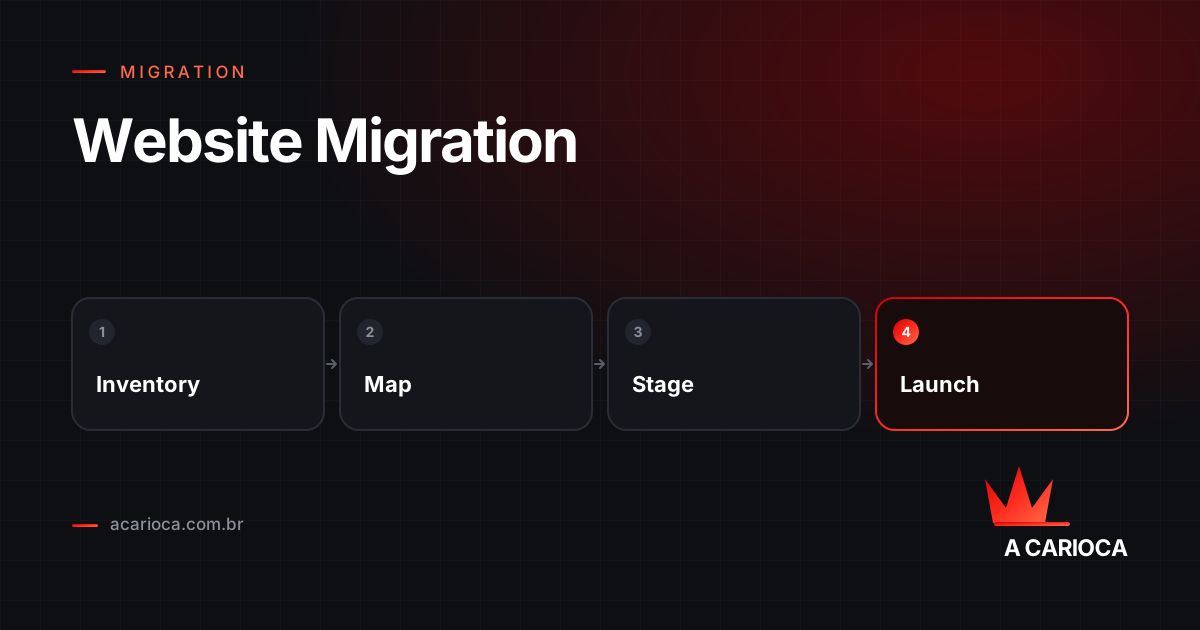
How we run a migration.
- 01
Inventory
Every existing URL, with its traffic and the links pointing at it.
- 02
Map
Each old URL to its closest new equivalent. Not everything to the home page.
- 03
Stage
Redirects tested on staging before launch, including the awkward edge cases.
- 04
Launch
Sitemap resubmitted, indexing requested, analytics continuity preserved.
- 05
Monitor
Crawl errors and rankings watched closely for the first weeks.
04 · Fit
Who migration support is for.
It fits any company changing domain, platform, URL structure or protocol: a rebrand, a move off an ageing CMS, a merger of two sites, a shift to a headless or static setup. The risk is the same in each case, and it is almost entirely manageable if the work starts before launch.
It fits sites with organic traffic worth protecting. A site with no rankings has little to lose; a site earning leads from search can lose most of them overnight with a blanket redirect to the home page.
It is a poor fit after the fact. We can recover a migration that went wrong, but it is slower and more expensive than doing it right, and some losses take months to reverse. Talk to us before the launch date is set.
05 · Common mistakes
Why migrations fail.
- Redirects treated as a launch-day task. Mapping every old URL takes real effort. Done under pressure it becomes everything to the home page.
- Redirect chains. Old to intermediate to final. Each hop loses signal and slows crawling.
- Content that shrinks. The new version has shorter text and generic titles. Google re-evaluates and the page drops, redirect or not.
- Staging settings shipped to production. A noindex or blocking robots.txt that goes live with the new site.
- Nobody watching afterwards. Problems surface over weeks. The first fortnight is when a mistake is still cheap.
A short dip while Google reprocesses the site is normal. A permanent loss is not, and it almost always traces back to one of the five items above.
06 · Measurement
How we measure and report.
Before launch: the full URL inventory, the redirect map and the test results. After launch: crawl errors, indexing status, rankings and organic traffic by page compared with the pre-migration baseline, weekly for the first month.
Pages that have not recovered after the expected period are investigated individually, because the cause at that point is local: the redirect, the content or the internal links of that page.
07 · Questions
Related services
Next step
Planning a redesign or a domain change?
Talk to us before launch, not after. The redirect map is the difference between a dip and a disaster.
- WhatsApp · +55 24 99929-8231
- Email · atendimento@acarioca.com.br
- Volta Redonda, Brazil · remote worldwide