
01 · LinkedIn Ads
LinkedIn Ads
LinkedIn costs more per click and often less per client.
You are paying for the ability to reach a specific job title at a specific kind of company. For complex sales, that is usually worth it.
LinkedIn Ads management covers B2B campaigns targeted by job title, seniority, industry and company size. Cost per click is high compared with other platforms, so the discipline is in qualifying tightly and measuring through to closed business rather than to form submissions.
What is included
What is included
- Title targeting
- Lead gen forms
- Long-cycle measurement
02 · Detail
Why a high cost per click can still be cheap.
A click from a purchasing director at a company of the right size is worth many clicks from an audience that will never buy. The mistake is comparing LinkedIn's cost per click to Google's without comparing what a client is worth in each channel.
The discipline that matters is exclusion. Targeting broadly on LinkedIn is expensive in a way it is not elsewhere, so we narrow aggressively: specific titles, specific company sizes, specific industries, and exclusions for people who will never have budget authority.
Lead gen forms convert well because they prefill from the profile, but they also produce leads with lower intent, since submitting takes two taps. We usually test those against a purpose-built landing page, because the cheaper lead is not always the better one.
03 · How it works
How we run B2B.
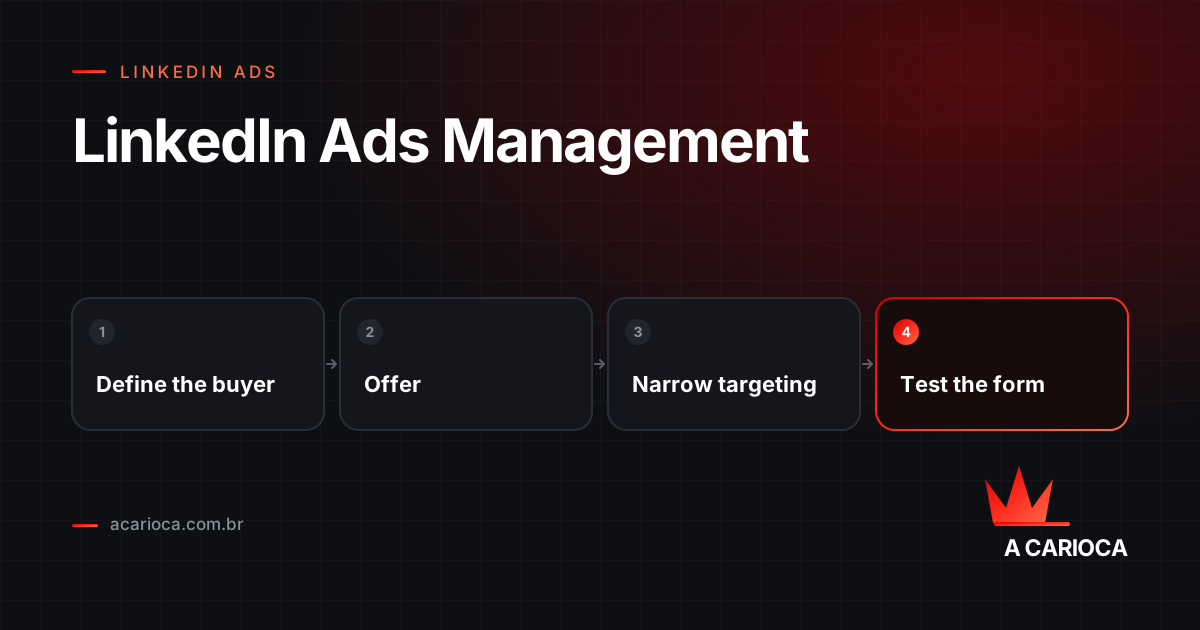
- 01
Define the buyer
Job titles and company profiles, specifically. Not the phrase "decision makers".
- 02
Offer
Something worth an email address from a busy senior person. A brochure is not.
- 03
Narrow targeting
Tight segments with deliberate exclusions, because breadth is expensive here.
- 04
Test the form
Native lead gen forms against a purpose-built landing page. Volume and quality differ.
- 05
Measure to revenue
Through to proposal sent and deal closed, not to form submitted.
04 · Fit
Who LinkedIn Ads is for.
LinkedIn fits B2B companies whose average contract justifies an expensive click: software, professional services, consulting, industrial suppliers, anyone selling to a specific job title at a specific kind of company. The platform charges a premium for that precision, and for the right ticket it is the most profitable channel available.
It fits sales teams that can absorb and follow up on leads promptly, because LinkedIn leads are senior people with short patience. It also fits companies with something genuinely useful to offer in exchange for an email: a benchmark, a diagnostic, a specific analysis.
It is a poor fit for low-ticket products, for consumer businesses, and for companies that judge channels on thirty-day windows. B2B cycles are long; judging LinkedIn before a full sales cycle has passed is judging it before any deal it started could have closed.
05 · Common mistakes
The mistakes we correct first.
- Broad targeting. "Decision makers" is not a segment. Specific titles, company sizes and industries, with deliberate exclusions, are.
- A brochure as the offer. Senior people do not exchange their email for a company overview. The offer has to be worth something to them.
- Lead gen forms only. They convert well and produce lower-intent leads. Tested against a landing page, the more expensive lead is often the better one.
- Measuring to the form. The number that matters is proposals sent and deals closed, which requires connecting the campaign to the CRM.
- Frequency left unmanaged. A small, senior audience sees the same ad many times. Rotation and caps protect the brand.
The common thread is precision: narrower audiences, better offers and measurement that reaches the pipeline. At LinkedIn prices, breadth is the expensive mistake.
06 · Measurement
How we measure and report.
We report cost per qualified lead and, with CRM integration, cost per opportunity and per closed deal. Lead quality is reviewed with the sales team monthly, because a cheap lead the team cannot use is not a result.
Targeting and creative are reported by segment, so you can see which titles and industries actually respond, and the plan adjusts to what the pipeline shows rather than what the platform dashboard shows.
07 · Questions
Technical guide
Related services
Next step
Selling B2B and struggling to reach decision makers?
Tell us who buys from you and what a client is worth. We will tell you whether LinkedIn makes sense at that ticket.
- WhatsApp · +55 24 99929-8231
- Email · atendimento@acarioca.com.br
- Volta Redonda, Brazil · remote worldwide