
01 · Technical SEO
Technical SEO
If Google cannot read the page, nothing else you do matters.
Technical problems are invisible to visitors and decisive for search engines.
Technical SEO is the work of removing everything that stops a search engine crawling, rendering and indexing your pages: server errors, blocked resources, slow Core Web Vitals, duplicate URLs, broken canonical tags and invalid structured data. It comes before content because content on an unreachable page earns nothing.
What is included
What is included
- Crawl and render
- Duplication
- Core Web Vitals
02 · Detail
The problems that cost the most.
Pages that render only after JavaScript executes are the most common serious issue we find. Google can render JavaScript, but it does so on a delay and imperfectly, so a site whose main content only appears after a framework loads is competing with one hand behind its back.
Duplicate URLs are the second. Filters, sorting parameters, session identifiers and both www and non-www versions can multiply one page into dozens, splitting whatever authority it had between them.
Core Web Vitals matter, but they are usually not the reason a site does not rank. When we find a site with poor vitals and no rankings, the vitals are typically the third problem, not the first. Fixing them while ignoring an indexing block is expensive theatre.
03 · How it works
What we check.
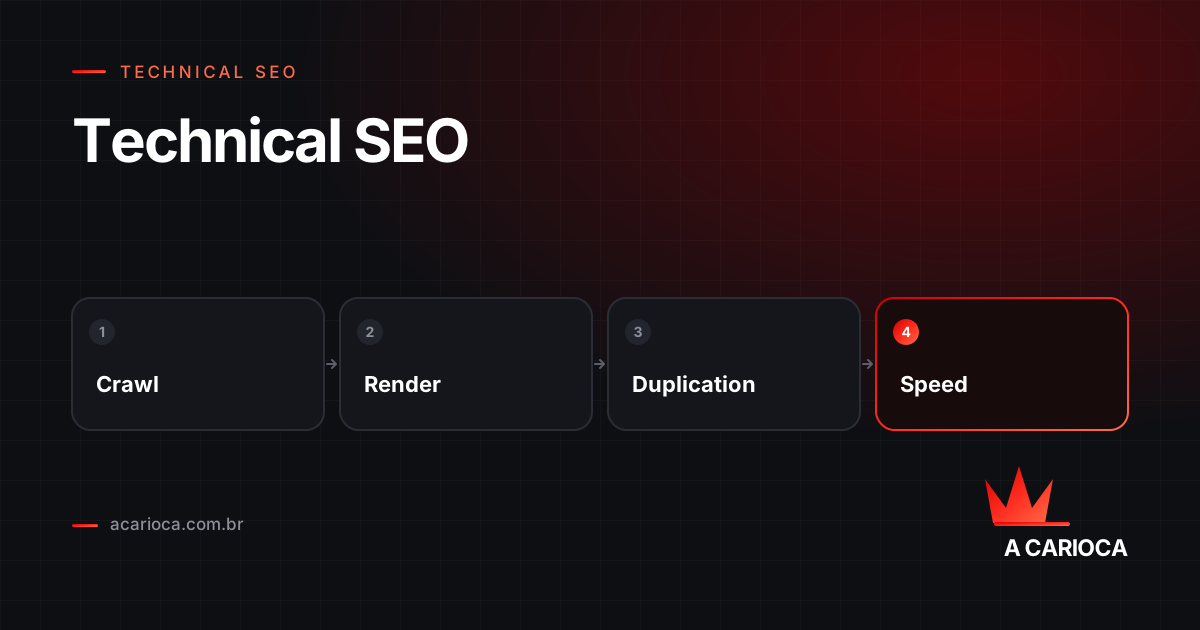
- 01
Crawl
Whether every page that should be reachable actually is, and nothing else is.
- 02
Render
What Google sees after JavaScript executes, compared with what a visitor sees.
- 03
Duplication
Canonical tags, parameters and protocol variants consolidated to one address.
- 04
Speed
Core Web Vitals measured on real user data, not only in a lab test.
- 05
Structured data
Valid, and matching the visible text. A mismatch is worse than no markup.
04 · Fit
Who technical SEO is for.
It fits sites where content is decent but visibility is not: pages that exist and are not indexed, rankings that dropped after a redesign or platform change, large sites with thousands of URLs, and anything built on a JavaScript framework where Google sees less than the visitor does.
It fits e-commerce with faceted navigation, sites that have accumulated years of plugins and redirects, and sites about to migrate. It also fits companies with an in-house team that needs a specification rather than a vendor.
It is a poor fit when the real constraint is content or authority. A technically clean site with nothing worth ranking still does not rank, and we say so rather than sell a technical project to a content problem.
05 · Common mistakes
The problems that cost the most.
- Content rendered only by JavaScript. Google renders on a delay and imperfectly. Server rendering or pre-rendering removes a whole class of problems.
- Duplicate URLs. Parameters, filters and protocol variants split one page into dozens and divide its authority.
- Staging settings in production. A noindex or a blocking robots.txt that went live with the new site.
- Redirect chains. Old to intermediate to final. Each hop loses a little and slows crawling.
- Structured data that contradicts the page. Worse than no markup; a mismatch is grounds to be ignored.
Core Web Vitals matter but are usually the third problem, not the first. Fixing speed while an indexing block stays in place is expensive theatre.
06 · Measurement
How we measure and report.
Indexed pages versus pages that should be indexed, crawl errors, render parity and Core Web Vitals from field data, reported monthly with the fixes shipped and their effect. Search Console is the primary source; log files when the site is large enough to need them.
Fixes are written as specifications a developer can implement, with the reasoning explained, so the work survives a change of team.
07 · Questions
Related services
Next step
Suspect something technical is blocking you?
Send the URL. We will tell you what Google can and cannot reach.
- WhatsApp · +55 24 99929-8231
- Email · atendimento@acarioca.com.br
- Volta Redonda, Brazil · remote worldwide