
01 · Google Ads
Google Ads
Google Ads captures demand that already exists.
Someone typing your service into Google has already decided they need it. That intent is what you are paying for.
Google Ads management covers search, Shopping, Display and Performance Max campaigns, structured so that budget follows purchase intent. Our benchmark is cost per qualified lead, and every account starts with a full audit of what is already running.
What is included
What is included
- Search campaigns
- Shopping
- Performance Max
02 · Detail
Where Google Ads budgets disappear.
Broad match without a disciplined negative keyword list is the single most expensive default in the platform. It will find you traffic, and a large share of it will be people researching, comparing or looking for a job.
Performance Max makes this harder, because it hides much of the search term data. It can work extremely well, but only with clean conversion data feeding it and a deliberate exclusion strategy. Handing it a badly defined conversion means teaching the algorithm to buy the wrong thing efficiently.
For accounts where a bad click is expensive, we usually keep a tightly controlled search campaign running alongside, so there is always a channel where every term is visible. Pair it with remarketing to recover the visitors who did not convert first time.
03 · How it works
How we structure an account.
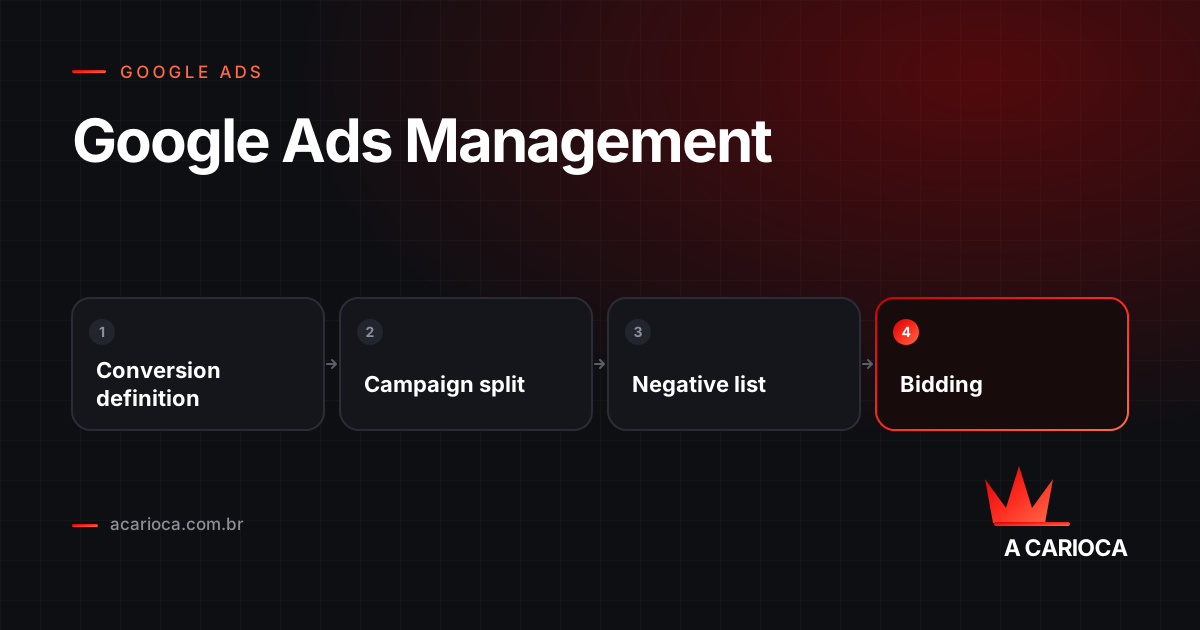
- 01
Conversion definition
Decide what counts as a lead before spending anything. A form view is not a lead.
- 02
Campaign split
Brand, high-intent and exploratory separated so one cannot hide the results of another.
- 03
Negative list
Built from real search term data weekly, not from a generic starter list.
- 04
Bidding
Manual or automated depending on data volume. Automation needs conversions to learn from.
- 05
Report
Cost per lead and revenue, not impressions and clicks.
04 · Fit
Who Google Ads management is for.
Google Ads fits any business people already search for: services with local demand, products with a known name, B2B categories with clear vocabulary. If your customers type what you sell into a search box, search campaigns are the shortest path from intent to contact, and usually the first paid channel we recommend.
It works particularly well for businesses that can answer quickly. A search click is a person who wants something now; a lead that waits a day for a reply has often already chosen someone else. Accounts paired with fast response and a clean landing page consistently outperform accounts with bigger budgets and slow follow-up.
It is a weaker fit for products nobody knows to search for yet, or for very low-ticket items where the cost of a click in your market exceeds the margin. In those cases we usually point to Meta, to remarketing, or to organic search, and say so before taking the budget.
05 · Common mistakes
The mistakes we correct first.
- Broad match with no negatives. The default that spends the most: relevant-looking traffic from people researching, comparing or job hunting.
- One campaign for everything. Brand, high-intent and exploratory terms in a single campaign means the cheap brand clicks hide the expensive generic ones.
- Performance Max with a weak conversion. Handed a page view as its goal, it buys page views efficiently across every Google channel.
- Ads sent to the home page. A specific search deserves a specific page. Generic landing pages pay a premium on every click through lower quality scores.
- Search terms nobody reads. The report exists in every account; in most, no one has opened it in months.
These are structural, not creative, problems. Fixing them usually cuts wasted spend by a visible margin in the first month, which is why we do it before proposing any new campaign or budget increase.
06 · Measurement
How we measure and report.
Cost per qualified lead or return on ad spend is the number, tracked against conversions that represent a real business outcome and validated against your CRM or store platform every week. Search term reviews, negative additions and bid changes are logged so the account history can be read by anyone who inherits it.
For lead-based businesses we import the outcome from the CRM back into Google Ads as an offline conversion, so the bidding learns from who became a customer rather than who filled in a form. That single change usually does more for cost per client than any amount of keyword work.
07 · Questions
Related services
Next step
Want to know where your Google Ads budget goes?
Send us access to the account. The audit is free and comes back with a priority list, not a sales pitch.
- WhatsApp · +55 24 99929-8231
- Email · atendimento@acarioca.com.br
- Volta Redonda, Brazil · remote worldwide