
01 · Meta Ads
Meta Ads
Meta creates demand that was not there yet.
Nobody opens Instagram looking for your product. That is the challenge and the opportunity.
Meta Ads management covers Facebook and Instagram campaigns, where the creative does most of the work. We structure audiences, test creative systematically and measure against real business outcomes rather than platform-reported engagement.
What is included
What is included
- Creative testing
- Conversions API
- Audience structure
02 · Detail
Creative is the targeting now.
Meta's algorithm has become good enough at finding buyers that narrow interest targeting is often counterproductive. What decides performance is the creative: the first second of the video, the specific claim, the offer. That is where testing budget should go.
This is why we treat ad creative production as part of the media work rather than a separate deliverable. An account with three creatives running for six months has stopped learning.
Attribution on Meta is genuinely harder since iOS privacy changes. We use the conversions API where possible and compare platform-reported numbers against what actually landed in the client's CRM, because those two figures rarely match and only one of them pays salaries.
03 · How it works
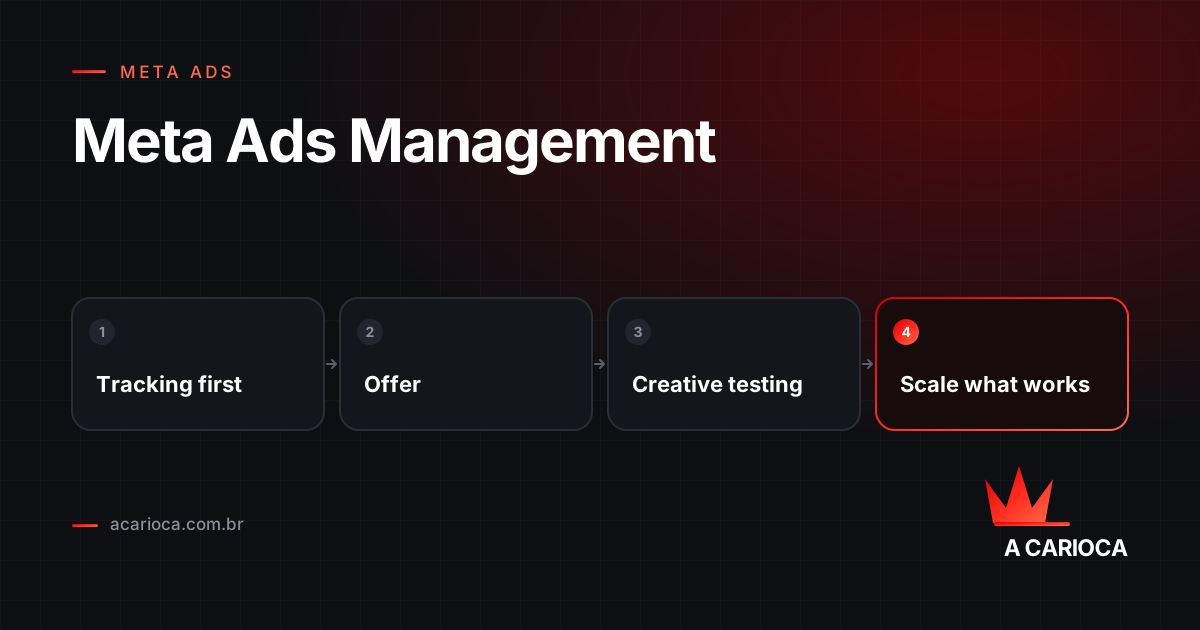
How we run Meta.
- 01
Tracking first
Pixel plus conversions API, verified against real sales data before scaling.
- 02
Offer
What is being promised. Weak offers cannot be fixed by better targeting.
- 03
Creative testing
Several genuinely different angles, not colour variations of the same idea.
- 04
Scale what works
Budget follows the creative that produces sales, not the one with the best engagement.
- 05
Refresh
Creative fatigue is real and measurable. We replace before performance collapses.
04 · Fit
Who Meta Ads management is for.
Meta fits products and services that can be understood in a scroll: visual products, offers with a clear before and after, local businesses with something worth showing, and anything bought on impulse or on a short consideration cycle. It also fits brands that already have search demand covered and need to create new demand rather than capture existing demand.
It fits e-commerce with a working catalogue and conversions API, and lead generation where the offer is concrete enough to be judged in a feed. Vague service descriptions do poorly on Meta because the platform gives you a second of attention, not a paragraph.
It is a poor fit for complex B2B sales to specific job titles, where LinkedIn reaches the right person more precisely, and for businesses with no creative capacity, because on Meta the creative does most of the work and a single tired ad cannot be fixed by targeting.
05 · Common mistakes
The mistakes we correct first.
- One creative running for months. Fatigue is measurable: cost per result rises while the audience stays the same. An account without new angles drifts downward.
- Trusting platform-reported conversions alone. Meta claims what it influenced within its window; the CRM records what closed. Decisions should follow the second number.
- Narrow interest targeting. The algorithm finds buyers better than a stacked list of interests does. Over-targeting starves delivery and raises costs.
- No conversions API. Pixel-only tracking loses a growing share of conversions on Apple devices; the server-side connection recovers much of it.
- Scaling the ad with the most likes. Engagement and sales are different metrics. Budget follows the creative that produces revenue.
Most of these are fixed by process rather than by spend: a creative rhythm, a tracking setup that survives privacy restrictions, and a weekly read of which angle is actually selling.
06 · Measurement
How we measure and report.
We report cost per purchase or per qualified lead, with platform numbers shown next to CRM or store numbers so the gap is visible and explained. Creative performance is reported by angle, not by ad ID, because the useful lesson is which message worked, not which file.
Frequency and cost-per-result trends are watched weekly to catch fatigue early. When a creative starts to decline, the report says so and shows what replaced it.
07 · Questions
Technical guides
Related services
Next step
Running Meta Ads without knowing what converts?
Send us your account. We will tell you which creative is carrying it and which is burning budget.
- WhatsApp · +55 24 99929-8231
- Email · atendimento@acarioca.com.br
- Volta Redonda, Brazil · remote worldwide