
01 · Planning
Planning
Most marketing problems are prioritisation problems.
Companies rarely lack ideas. They lack agreement on which three matter this quarter.
Strategic planning is the work of deciding what a company should do in marketing and in what order: understanding the offer and the buyer, finding where the funnel leaks, choosing channels deliberately and setting the measurement that will show whether it worked.
What is included
What is included
- Diagnosis
- Channel choice
- Success measures
02 · Detail
Diagnosis before channels.
A company with plenty of traffic and no sales needs the opposite of one with a converting page and no visitors. Choosing channels before establishing which of those you are is how budget gets spent on the wrong problem competently.
Most funnels have one dominant constraint at a time. Fixing anything other than the constraint produces almost no change in results, which is why marketing spend sometimes doubles with nothing to show.
The plan should also say what not to do. A list of twelve initiatives for a team of two is not a plan; it is a way of guaranteeing that everything progresses slowly and nothing finishes.
03 · How it works
How planning runs.
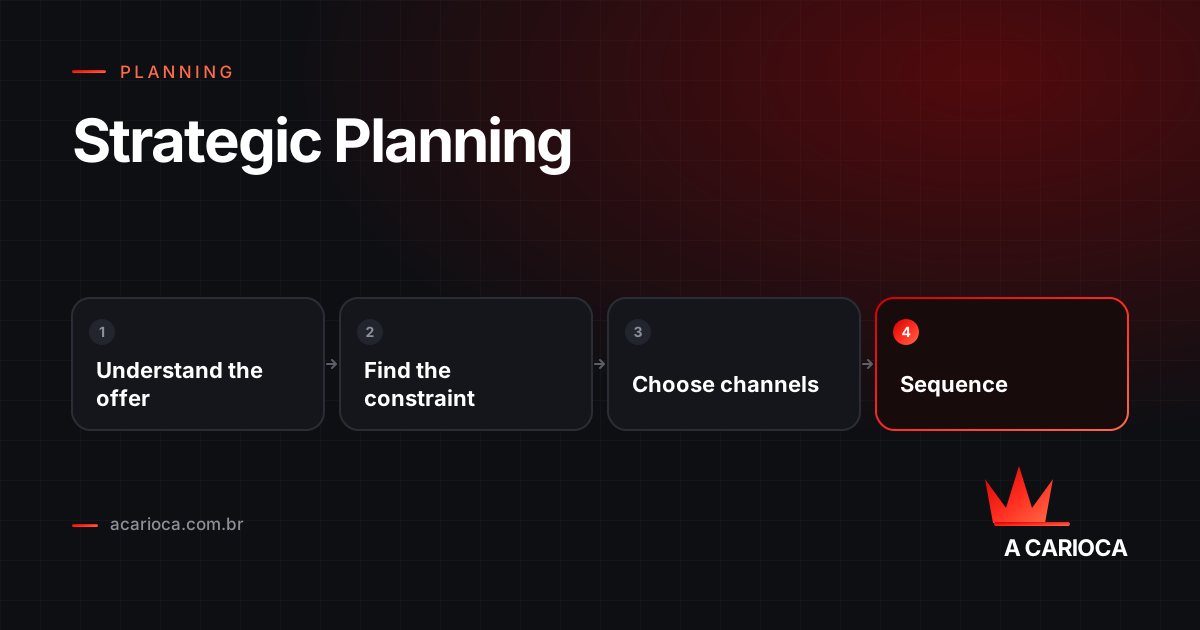
- 01
Understand the offer
What is sold, to whom, at what value, against which alternatives.
- 02
Find the constraint
Where the funnel actually leaks, measured rather than assumed.
- 03
Choose channels
Deliberately, from where the buyers are and what the constraint is.
- 04
Sequence
What comes first, and explicitly what is postponed.
- 05
Define success
The numbers that will show whether it worked, agreed before starting.
04 · Fit
Who strategic planning is for.
It fits companies with more ideas than capacity: a list of twelve initiatives for a team of two, budget spread across channels chosen by habit, results that doubled in spend and not in sales. It fits businesses that have tried several things without agreeing on which problem they were solving.
It fits companies at a decision point: entering a new market, launching a product, choosing between SEO and paid traffic first, deciding whether the constraint is traffic, conversion or follow-up. Planning is the pause that makes the next quarter deliberate.
It is a poor fit when the constraint is obvious and the channel is clear. In that case planning is a way of postponing action, and we say so. It is also not an annual document: a quarter in detail, a year in direction, because digital channels change too fast for more.
05 · Common mistakes
The mistakes planning prevents.
- Channels chosen before diagnosis. A company with traffic and no sales needs the opposite of one with a converting page and no visitors.
- Fixing something other than the constraint. Most funnels have one dominant leak at a time. Work elsewhere produces almost no change.
- A plan with no "not doing" list. Twelve initiatives for two people guarantees everything progresses slowly and nothing finishes.
- Success measures agreed afterwards. The numbers that show whether it worked are set before starting, or the plan cannot be corrected.
- Sizing the plan to look impressive. It is sized to what the team can execute, because a plan nobody implements is worthless.
Most marketing problems are prioritisation problems. The plan is the agreement on which three things matter this quarter.
06 · Measurement
What you receive.
A written plan covering the offer and the buyer, where the funnel leaks, which channels and in what order, what is explicitly postponed, and the measures that will show whether it worked. It is short enough to be read and specific enough to be executed.
A review at the end of the quarter against those measures, so the next plan is corrected by evidence rather than by preference.
07 · Questions
Technical guides
Related services
Next step
Not sure where to start?
Tell us what you sell and what you have tried. We will tell you what the constraint probably is.
- WhatsApp · +55 24 99929-8231
- Email · atendimento@acarioca.com.br
- Volta Redonda, Brazil · remote worldwide